
.avif)
You stopped working months ago, your savings are running thin, and somewhere in a stack of paperwork is a form asking you to prove to the federal government that you can't hold a job. If that's where you are right now, the question on your mind is probably simple: what does it actually take to qualify for Social Security disability in Texas?
The answer is more concrete than most people expect. The Social Security Administration (SSA) doesn't approve or deny claims on a hunch. It runs every application through the same structured process, looking at specific things in a specific order: how much you're earning, how severe your condition is, whether it matches a medical listing, and whether your age, education, and past work leave you any realistic way to earn a living. Our Social Security Disability lawyer has prepared this guide to walk you through that process step by step, so you can see where your own situation fits before you ever fill out a form.
What "Disabled" Means to the SSA
Social Security uses a narrow legal definition of disability, and it's stricter than what most people picture. There is no such thing as a partial or short-term award here. To qualify, you must have a medically determinable physical or mental impairment (or a combination of them) that:
- Prevents you from doing substantial gainful activity (SGA), and
- Has lasted, or is expected to last, at least 12 continuous months, or is expected to result in death.
That second point trips up a lot of applicants. A serious injury that puts you out of work for four months, however painful, will not qualify on its own. The SSA is looking for long-term or permanent inability to work, not temporary recovery.
The first point hinges on a dollar figure. For 2026, the SGA threshold is $1,690 per month for non-blind individuals (and $2,830 for those who are statutorily blind). If you are working and earning above that amount, the SSA will generally stop and find you not disabled before it ever looks at your medical records. These limits are based on gross monthly earnings, and they adjust each year.
SSDI or SSI: Which Program Are You Applying For?
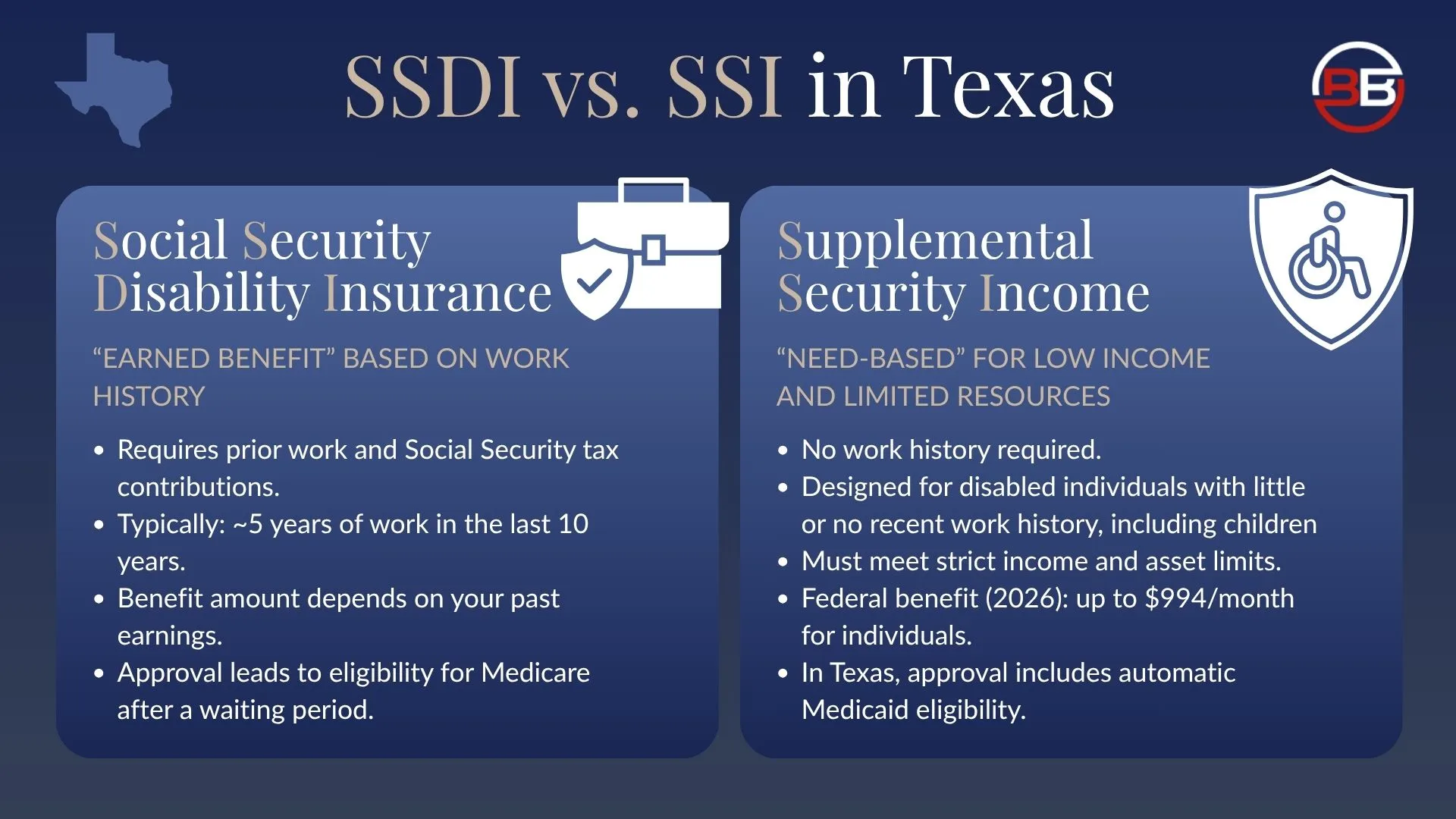
There are two federal disability programs, and qualifying for one is not the same as qualifying for the other. The medical standard is identical for both, but the non-medical eligibility rules are completely different.
- Social Security Disability Insurance (SSDI) is an earned benefit. You qualify based on your work history, specifically the work credits you've built up by paying Social Security taxes over the years. Most adults need to have worked roughly 5 of the last 10 years. Your monthly payment is tied to your prior earnings, and approval eventually opens the door to Medicare.
- Supplemental Security Income (SSI) is need-based. It does not require a work history at all, which makes it the path for people who haven't worked enough recently to qualify for SSDI, including disabled adults with little work history and disabled children. Instead of work credits, SSI looks at your income and resources, which must fall below strict limits. The 2026 federal benefit rate for an eligible individual is $994 per month, and in Texas, an SSI approval brings automatic Medicaid eligibility.
Some people qualify for both at once. If your work history is thin and your income is low, you may receive a concurrent claim. Sorting out which program fits is one of the first things to work through, because applying under the wrong one wastes time you may not have.
The Five-Step Evaluation: How the SSA Actually Decides
Every claim, for either program, runs through the same five-step sequential evaluation. The SSA works through it in order and stops the moment it reaches a decision. Understanding these five steps is the clearest way to see whether you qualify and where a claim tends to break down.
- Step 1 — Are you working above SGA? This is the income gate from earlier. If you're earning more than $1,690 a month in 2026, the SSA finds you not disabled and stops here, regardless of your diagnosis. If you're below that line, you move to step two.
- Step 2 — Is your condition "severe"? Your impairment has to significantly limit your ability to do basic work activities such as standing, walking, lifting, concentrating, or remembering. A condition that's minor or well-controlled won't clear this step. The 12-month duration requirement applies here as well.
- Step 3 — Does your condition meet a Blue Book listing? The SSA maintains a reference called the Listing of Impairments, commonly called the "Blue Book", organized by body system. Each listing spells out the exact clinical findings and medical evidence required. If your condition matches a listing, you're approved at this step. Meeting a listing is the fastest route to a yes, but most approved claims don't get there, which is why steps four and five matter so much.
- Step 4 — Can you do your past work? If you don't meet a listing, the SSA assesses your residual functional capacity (RFC), meaning what you can still do despite your impairment. It then asks whether that capacity is enough to perform any job you've held in the past 15 years. If you can still do your old job, the claim is denied here.
- Step 5 — Can you do any other work? This is the final and most decisive step for most Texas claimants. The SSA asks whether, given your RFC, age, education, and work experience, there is any other work in the national economy you could realistically do. If the answer is no, you're approved.
#cta_start
Not Sure Which Step Your Claim Falls On?
The five-step process decides everything, and most denials happen because a claim is weak at step four or five. Before you guess, let us look at where your case actually stands.
#cta_end
Why Age and Work History Can Decide Your Claim
Step five is where one of the most powerful and most overlooked rules in disability law comes into play: the SSA's Medical-Vocational Guidelines, known as the Grid Rules.
If you are under 50, the SSA generally expects that you can be retrained for some kind of work, even sedentary desk work, so you usually have to prove you can't perform any job in the national economy. The bar is high. Once you reach 50, and even more so at 55, the Grid Rules shift in your favor. The SSA recognizes that a worker who has spent decades in physical labor can't simply be retrained into an office job late in their career. For an older claimant with a history of manual labor and limited transferable skills, an RFC limited to sedentary or light work can lead to approval where a younger person with the identical medical condition would be denied.
This is why the same diagnosis produces different outcomes for different people. A 56-year-old who spent 30 years in construction and a 38-year-old office worker can both have severe degenerative disc disease and end up with opposite decisions. The medical condition is only part of the picture; your age and the kind of work you've done carry real weight at step five.
The Evidence That Wins Claims

Once you're past the gatekeeping steps, your claim lives or dies on medical evidence. The SSA cannot approve what isn't documented, and "I'm in pain" is not evidence. What it needs to see is an objective, consistent record built by your treating providers.
Strong claims tend to share the same foundation:
- Consistent, ongoing treatment. Regular visits create the paper trail the SSA evaluates. Gaps in care are one of the most common reasons otherwise valid claims fall apart. If you can't afford care, county facilities such as Parkland in Dallas County or John Peter Smith (JPS) in Tarrant County can establish the treatment history the SSA requires.
- Objective testing. Imaging, lab work, pulmonary function tests, ejection fraction readings, neuropsychological testing — the specific evidence depends on the condition, but the SSA leans hardest on findings it can measure.
- Functional documentation from your doctor. A treating physician's assessment of exactly what you can and can't do (how long you can sit, stand, or walk, how much you can lift, how often you'd need to rest) is what translates a diagnosis into a work limitation the SSA can act on.
- Accurate Work History and Function Reports. These SSA forms determine how the agency understands your past jobs and your current limitations. Mistakes on them are a leading cause of avoidable denials, because they feed directly into the step-four and step-five analysis.
What Conditions Qualify
Almost any serious medical condition can support a claim if it limits your ability to work severely enough and is well documented. The SSA evaluates impairments across every body system, including musculoskeletal and orthopedic conditions, cardiovascular disease, cancer, neurological disorders, respiratory and digestive disease, immune and endocrine disorders, and sensory impairments.
Mental health conditions matter too, though they follow their own pattern. Conditions like depression, anxiety, PTSD, and bipolar disorder are difficult to win as standalone primary claims, but they are powerful as secondary conditions documented alongside a primary physical impairment. When your body breaks down, your mental health often follows, and a complete claim reflects that full picture.
A handful of the most severe diagnoses skip much of the wait entirely. Under the Compassionate Allowances (CAL) program, certain conditions, including many aggressive and metastatic cancers, ALS, and early-onset Alzheimer's, are presumed disabling by diagnosis alone and can be fast-tracked in weeks rather than months.
Why Genuine Claims Still Get Denied

The SSA denies most initial applications in Texas and nationwide. The reasons usually have less to do with whether someone is truly disabled and more to do with how the claim was built:
- Earning above the SGA limit, which ends the evaluation at step one no matter how severe the condition.
- Thin or inconsistent medical records, leaving the SSA nothing objective to evaluate.
- A condition that's well-controlled by medication, unless the side effects themselves are disabling.
- Errors on the Work History or Function Report, which distort the step-four and step-five analysis.
- Applying under the wrong program, or filing before the 12-month duration can be established.
Already Been Denied?
A denial is not the end, and for most successful claimants it's only the middle. The majority of disability awards come at the appeal stage, not at the initial application. You have 60 days from the date of your denial letter to file a Reconsideration appeal. If that's denied, the next step is a hearing before an Administrative Law Judge (ALJ), which is statistically where the most claims are won. Beyond that, the SSA Appeals Council and federal district court remain available.
The one thing not to do: don't start a new application. Filing fresh after a denial restarts the clock and wipes out the back pay you've accumulated. File the appeal instead.
Find Out Where You Stand
Qualifying for Social Security disability in Texas comes down to clearing the five-step process with a record strong enough to back up every limitation you claim. That's rarely something you can build alone. The rules are technical, the deadlines are unforgiving, and a single paperwork mistake can cost you months of back pay.
If you're in Texas and trying to figure out whether you qualify for SSDI or SSI, talking to an experienced Social Security Disability attorney is the most reliable way to get an honest read on your case. At The Law Office of Burke Barclay, we offer free case evaluations with no obligation to sign up. We work on a strict contingency basis, with no fee unless we win, and we never charge administrative fees or costs even if your case is unsuccessful. Contact us today to schedule your free evaluation. Hablamos Español.

He practices in Social Security hearing offices throughout the United States for claimants who have been denied their SSI or SSDI benefits. He personally represents every client from the beginning stages of their disability claim to their hearing or possible appeal.
You Worked Hard. Make the System Keep Its Promise.
You paid into this system for years. Now that you need it, the process shouldn't feel designed to push you out. We'll review your case for free, no obligations.
- Request Your Free Consultation
- or Call Us Directly
 (888) 780-9125



.webp)